Space Heater Buying Guide
Disclosure: This page contains affiliate links. If you buy through them we may earn a commission at no extra cost to you. As an Amazon Associate I earn from qualifying purchases. Details.
A space heater is a high-wattage appliance placed close to people, furniture, and fabric, so safety comes first. The NFPA reports that space heaters and heating stoves accounted for about 30% of home heating equipment fires but 73% of the deaths in those fires (2020-2024 annual averages). The CPSC estimates portable heaters are involved in about 1,600 fires per year (2020-2022 average). A careful choice and careful use matter.

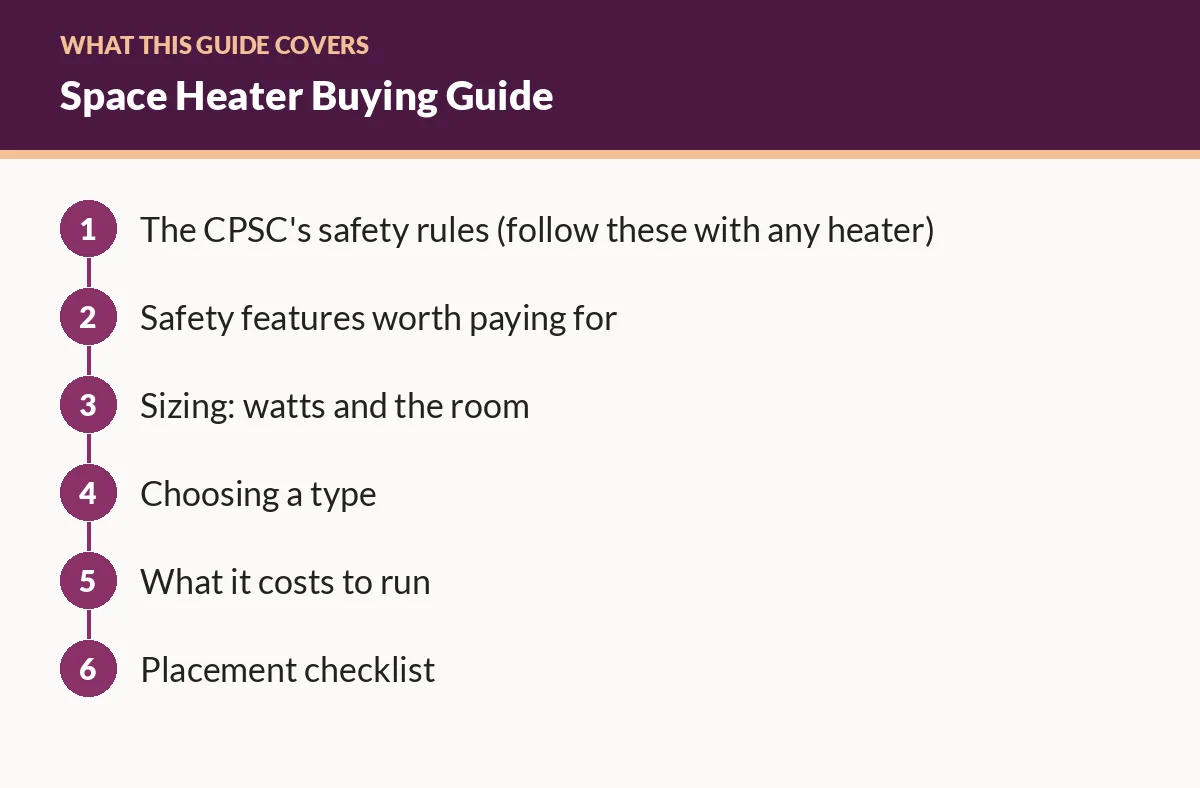
We haven't lab-tested heaters, and we don't rank models. This guide covers what to look for and how to use one safely.
The CPSC's safety rules (follow these with any heater)
- Keep heaters at least three feet from drapes, furniture, bedding, and other combustible materials.
- Plug electric heaters directly into a wall outlet, never into an extension cord or power strip.
- Turn heaters off when sleeping.
- Place it on a stable, level surface where it won't be knocked over.
- Never leave a heater running unattended.
- Be mindful of children and pets around heaters.
- Check whether your heater has been recalled at cpsc.gov/recalls.
- Have working smoke and CO alarms on every level of the home (CPSC).
Safety features worth paying for
| Feature | What it does |
|---|---|
| Tip-over shut-off | Turns the heater off if it's knocked over |
| Overheat protection | Shuts off if internal parts get too hot |
| Cool-touch exterior | Lowers burn risk around kids and pets |
| Safety certification mark | Shows testing by a recognized lab |
| Thermostat | Cycles off when the room is warm (saves energy, too) |
| Timer | Shuts off after a set time |
| Sturdy cord and snug plug | A loose or hot plug or outlet is a warning sign; stop using it and have it checked |
Heaters with tip-over and overheat protection → Amazon
Sizing: watts and the room
Many portable electric heaters are rated around 1,500 watts on high, with a lower setting around half that. Check the label. A heater supplements central heat. It's meant to warm a room or the area around you, not a whole house. Draftier rooms with more windows need more heat to feel warm; sealing drafts first helps (see cheap draft fixes).
Choosing a type
- Ceramic (fan-forced): warms a small room quickly; compact.
- Oil-filled radiator: slow to warm, gentle steady heat, quiet.
- Infrared/radiant: warms people and objects in front of it; good for spot heating.
Full comparison: oil-filled vs. ceramic vs. infrared.
What it costs to run
Electric heaters cost the same per watt-hour regardless of type. A 1,500 W heater on high uses 1.5 kWh per hour. At the EIA's July 2026 U.S. average residential price (18.31¢/kWh), that's about 27¢ an hour. Try your own numbers in the cost calculator.
Placement checklist
- [ ] Three feet clear on all sides
- [ ] Plugged straight into the wall (and the plug fits snugly)
- [ ] Cord not under a rug or across a walkway
- [ ] On a hard, level floor
- [ ] Away from water
- [ ] Out of a high-traffic path where kids or pets could knock it over
Fuel-burning heaters: extra rules
Fuel-burning portable heaters produce combustion gases. The CPSC says never to refuel a heater while it's in use; turn it off and let it cool first. Fuel-burning heating can produce carbon monoxide, so working CO alarms are essential. Never use outdoor-only heaters, grills, or generators indoors. This site focuses on electric heaters.
When a heater isn't the answer
- The room is cold because of drafts: fix those first.
- You're the only one in the room and sitting still: a heated blanket or throw uses far less energy. See blanket vs. heater.
- The whole house is cold: have your heating system checked. The CPSC recommends annual professional inspection of fuel-burning heating systems.
FAQ
Can I plug a space heater into an extension cord?
No. The CPSC says to plug electric space heaters directly into a wall outlet, never into an extension cord or power strip.
Is it safe to leave a space heater on overnight?
The CPSC says to turn heaters off when sleeping, and never to leave a portable heater running unattended.
What safety certification should a space heater have?
Look for a certification mark from a recognized testing laboratory on the heater and its packaging, and check cpsc.gov/recalls before using any heater.
Related guides
- Space Heater Cost Per Hour Calculator
- Oil-Filled vs. Ceramic vs. Infrared Space Heaters
- Heated Blanket vs. Space Heater: Which Costs Less?